Amirhossein Bayani
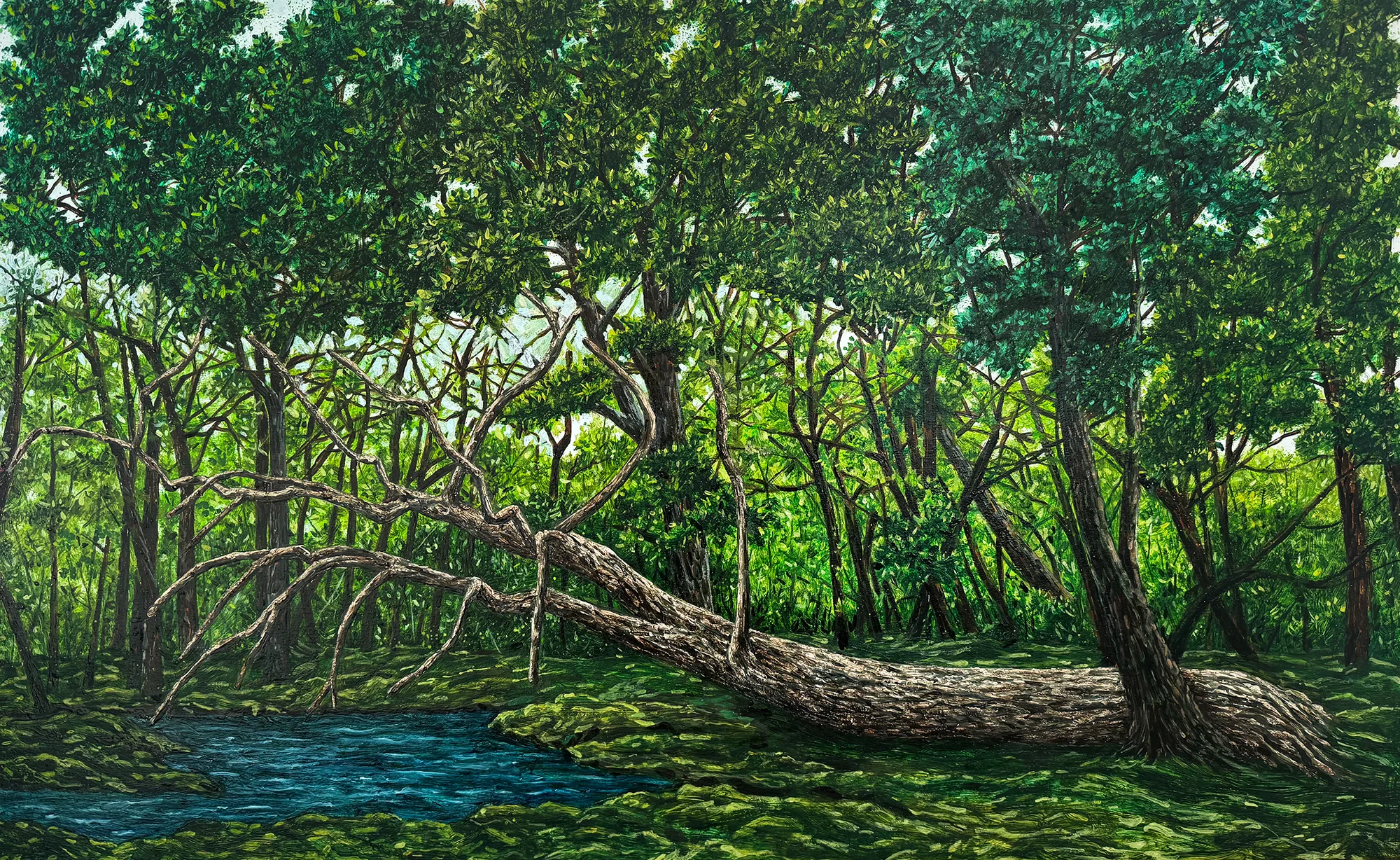
The Dragon Lives
2026Oil on board60 x 97cm
If I were to describe my intellectual project in a single word, that word would be politics—not politics in the everyday sense of current affairs or the news cycle, but politics as a philosophical and intellectual inquiry. I am interested in politics as a field of thought, a domain of critical reflection, and a practice of emancipation. My work develops through subjects that engage with political questions, including the condition of minorities, women’s rights, vulnerable individuals and communities, resistance, protest, and the confrontation of oppression. In particular, I focus on the ways power operates through violence, sabotage, and tyranny.
I am a painter, visual artist, curator, and founder of MERXOUT Projects. Born in Tehran in 1977, I studied painting at Tehran University School of Art before completing an M.F.A. in Art Research at Tehran Azad University. My work has been exhibited extensively in solo and group exhibitions internationally, and I now live and work in London.
Visually, my work is most often articulated through landscape and the representation of nature. I approach political and social questions through this visual language. Nature fascinates me because of its grandeur, authority, and contradictions. It can be harsh and unforgiving, yet profoundly beautiful. It embodies vulnerability and strength, destruction and renewal, and remains, for me, a space of possibility, liberation, and hope. This tension between political inquiry and the imagery of the natural world forms the central framework of my practice.
Hampstead Heath occupies a special place in my imagination and intellectual life. More than a park or landscape, it functions as a symbol of emancipation. Moving through its wooded paths and open fields, I am reminded of resilience, renewal, and the possibility that hope has not entirely disappeared. I return to it not simply to observe it, but to think through it. What fascinates me is precisely this capacity of a place to transcend its material reality and become a site of thinking that continuously invites reflection on what it means to live, to hope, and to imagine otherwise.
About The Dragon Lives
“I first encountered this tree while walking through Hampstead Heath. Something about it stopped me instantly. It seemed to hold a quiet reflection of my own journey, while also speaking to something deeply universal.
Among the beauty of the landscape, it was this broken tree that captured my attention. I was drawn not to its fall, but to its persistence. Though its trunk had split and it lay against the earth, its roots remained firmly embedded in the soil. It was still alive.
For me, the tree became a meditation on resilience—the silent strength to endure, to remain rooted through hardship, and to continue living despite what has been lost. It carries traces of struggle, hope, and the possibility of renewal.
A friend affectionately referred to it as ‘the dragon tree,’ and the name immediately resonated with me. It transformed the tree into something mythical: wounded, yet powerful; grounded, yet enduring. From that moment, the title The Dragon Lives felt inevitable.
This painting is not simply about a tree. It is about the quiet courage to keep living, to remain rooted, and to believe that even after being broken, life continues.”
A.B. 2026